

Every November, South Korea grinds to a halt for its well-known college admissions test.
Stores close, air travel is postponed to minimize noise, and even the rhythm of the morning commute decelerates for the test-takers.
By late afternoon, most test-takers walk out of school gates, exhaling with relief and embracing the relatives waiting outside.
However, some individuals finishes at that hour. Even once darkness has fully settled and night has set in, some students remain in the exam room – finishing close to 22:00.
They are the visually impaired examinees, who often spend more than 12 hours completing the longest version of the Suneung.
The Endurance Test
On Thursday, over 550,000 students across the country will take the Suneung – a shortened form for College Scholastic Ability Test in Korean. It is the highest number of test-takers in almost a decade.
The test not only dictates if people will be able to go to university, but can affect their job prospects, income, future residence and even future relationships.
Based on their subject choices, examinees complete roughly 200 problems across language, math, English, science subjects, second language, and Hanja.
For most students, this constitutes an full-day marathon of back-to-back exams. They begin the Suneung test at 8:40 AM and conclude approximately 5:40 PM.
Visually impaired test-takers with severe visual impairments, however, are given almost double the regular exam time.
Consequently, when completing the optional language section, the test can finish as far as 21:48 – almost 13 hours after it began.
There is no dinner break; the exam continues straight through.
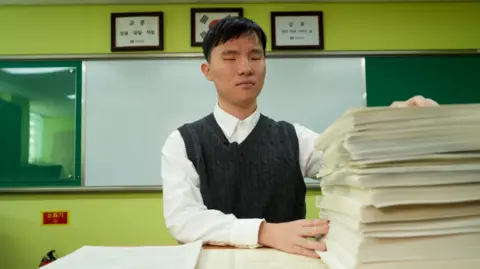
The physical bulk of the braille test papers also contributes to the duration.
As each phrase, symbol and diagram is converted into braille, every exam document becomes six to nine times more voluminous than the regular version.
Personal Experiences
In a specialized educational institution, teenage Han Donghyun is one of the students who are preparing for the longest version of the Suneung currently.
Previously, there were over a hundred blind test-takers nationwide – ninety-nine with low vision and twelve with severe visual impairments like the student – according to data from educational authorities.
The student was born completely blind and is unable to perceive light.
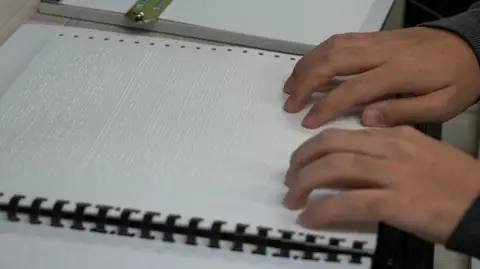
When meeting at his school, his hands moved rapidly across a tactile training material of past exam questions.
Approaching the examination date, he was concentrating on managing his stamina and condition. He will take the exam using tactile materials and a audio assistance device.
"It's really exhausting because the exam is so long," he said. "However, no unique method exists. I simply adhere to my preparation plan and try to manage my well-being. That's the only way."
Dong-hyun explained the language component is particularly difficult for him.
Regular examination materials for that section is about 16 pages – but the tactile edition is roughly 100 pages long.
Despite using audio assistance, spoken information disappears as soon as it is perceived, contrary to written content that can be viewed and reviewed. He has to hold the details in his memory as he goes.
Math component is no easier.
He needs to comprehend complex graphs and tables that have been converted into tactile format, solely through his touch.
Still, he noted that conditions have improved than they were previously. In the past, examinees had to do nearly every calculations in their memory. However, recently, blind test-takers have been permitted to use a braille notetaker, known as Hansone.
"Similar to those with vision document their work in pencil, we input them in tactile format on the Hansone to track progress," he said.

Physical Demands
A different examinee at the institution, teenage Oh Jeong-won, who will likewise complete the exam currently, said the evening hours are "the hardest point" of the day.
"Before the midday break, it's tolerable," he said. "However, during late afternoon, following language sections and before Korean History, that period it gets really tough.
"There's no dinner break," he explained. "We continue answering questions during the time we would normally eat, so fatigue increases. Nevertheless, I persist because I know there will be a feeling of achievement at the end."
For the student, the fatigue is compounded by the necessity to stay highly concentrated with both his hands and his hearing.
"While processing the braille with my hands and also taking in content through sound, it seems significantly more exhausting than it does for sighted students," he said.
Study Challenges
But the students say that the length of the exam and the extended preparation are not the hardest part. The main difficulty is access to learning resources.
Popular textbooks and online lectures that sighted students depend on are often inaccessible.
There are very few tactile editions, and transforming resources into audio needs having text files – which are difficult to obtain. In many cases, someone has to manually type entire workbooks to make them usable.
Online lectures also pose difficulties, as numerous educators explain concepts using visual notes, illustrations and images on screen, which cannot be followed through sound only.
One of the most significant barriers, however, is the delay in receiving braille versions of the state-produced study materials – a core set of materials directly connected to the standardized test.
Due to this postponement, blind students often receive the resources with significant delay than their peers.
"Those with vision get their EBS books early in the year and use them for the entire period," explained the student. "We obtain the braille files approximately in August or September, when the test is just a few months away."
Dong-hyun shared the identical worry.
"Tactile resources weren't ready before under three months before the exam," he said. "I consistently hoped the production timeline could be faster."
The responsible organization, which produces the braille version of preparation resources, stated that the procedure takes at least three months for each book because it needs to adhere to relevant guidelines.
The institute added that it is "implementing multiple initiatives to guarantee that blind students can learn uninterrupted, including creating and supplying the materials in separate volumes."
An advocacy group said it has long raised these concerns with {author
